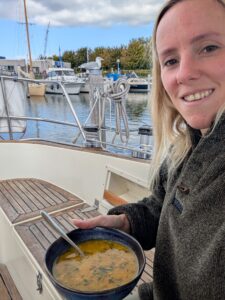
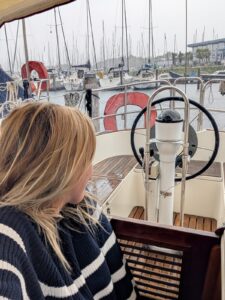
My First Year Living Aboard Delta Lady in the Netherlands
I got the advertisement for Delta Lady in my mailbox because I set out a special request for a Najad. When I saw it I reached out immediately. I was the first person to respond, and three days later I went to see her twice. The first time I went alone, because I wanted to feel what the boat was like without anyone else’s opinion influencing me. Later that day I returned with a sailing friend, and we looked at her again with a more practical eye. We opened lockers, inspected the systems and tried to understand what would need attention.
Delta Lady was not perfect. She was nearly forty years old and going to require work. But she also felt solid, safe, and like mine. Before I officially owned her, I already had the feeling that she belonged to me.
Buying a Boat on My Birthday
The purchase was completed on my birthday, 4 August 2025. It felt symbolic. I was not only becoming a year older, I was buying a home, a project and the beginning of a different lifestyle.
Before the purchase, Delta Lady underwent a survey. For me, that was essential. I was planning to live aboard an old sailing boat, so I needed more than a beautiful interior and a good feeling. I needed a professional assessment of the hull, structure, engine, rigging and general condition.
The survey gave me enough confidence to continue, but it also taught me an important lesson. A survey does not mean that nothing will ever break. It mainly tells you whether the boat is fundamentally sound enough to take responsibility for everything that comes next.
And a lot came next.
Moving Aboard
Soon after buying her, I moved aboard. During the first nights, everything felt new. The sound of ropes outside, footsteps on the pontoon, rain on the deck and the small movements of the boat all seemed important.
Living on a boat means becoming aware of sounds and movements that people in houses barely notice. Wind does not simply pass the windows. It moves the entire home. Rain does not land somewhere far above the ceiling. It falls directly onto the deck, only a short distance from where you are sleeping.
At first, I listened to every sound.
Was the rope tapping against the mast mine?
Was something leaking?
Was that sound coming from outside or from inside a cupboard?
Over time, most of these sounds became familiar. I was not only learning to live aboard. I was learning the language of my boat.
The First Two Weeks Without Shore Power
My first weeks aboard were not especially luxurious. The existing shore power installation did not feel safe enough to continue using, so I had to remove it.
That was the correct decision, but it also meant that I had no normal 230 volt supply for roughly two weeks. No convenient sockets, no easy charging and no electric comfort without thinking about where the energy would come from.
Suddenly, ordinary things required planning.
Where could I charge my phone?
How long would the batteries last?
Which lights could I use?
How would I keep food cold?
In a house, electricity is almost invisible. On the boat, I became aware of every device I charged and every light I switched on.
Those first weeks felt like a small survival exercise. Not survival in the dramatic offshore sense, but the practical kind where you gain a deep appreciation for a normal wall socket.
The missing shore power later became the beginning of a major electrical refit. At the time, it mostly taught me that comfort on a boat is never automatic. It depends on systems that have to be safe, reliable and understood.
My First Solo Sail
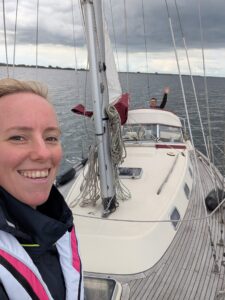
Owning a sailing boat and sailing one alone are two very different things. My first solo sail on Delta Lady was exciting, but mostly it was terrifying.
Once I left the berth, I was responsible for everything. Steering, lines, fenders, engine, sails, navigation, other boats and eventually getting back into the marina.
The sailing itself was not the part I feared most. I was especially nervous about returning to the box alone.
In a marina, the berth is narrow and the neighbouring boats are close. With two people, one person can steer while the other handles the lines. Alone, you are both people.
Before returning, I prepared everything carefully. The fenders were ready, the lines were placed where I could reach them and I thought through the approach several times.
Where would the wind push me?
Which line did I need first?
What if I missed the pole?
What if the boat kept moving?
And, slightly less technically important but emotionally very present, what if everyone was watching?
I managed it. It was not elegant, but Delta Lady returned to her berth without damage and I secured her alone.
That moment meant much more than simply parking the boat. It proved that I could do something I had been genuinely afraid of.
I did not suddenly become fearless after that. Solo sailing continued to challenge me, especially after longer periods without practice. But the first time changed something. Delta Lady was no longer only the place where I lived. She had become a boat I could take out myself.
Learning the Marina
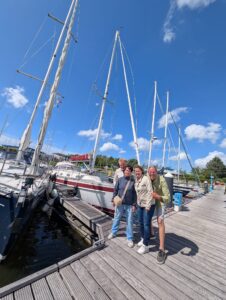
A marina is a strange kind of neighbourhood. People live close to each other, but everyone has their own floating world. You may know someone by their boat, their dog or the sound of their engine.
If the weather became rough, people checked each other’s lines. When I was away, there were eyes on the boat. If something looked unusual, someone would mention it. When I struggled with a practical job, someone often had a tool, a suggestion or a story about how the same thing had once gone wrong for them.
Boat people can be wonderfully direct. Someone may tell you that a line is wrong before asking your name. But that directness can also feel reassuring.
Living aboard alone did not mean nobody was looking out for me.
A Small Space That Felt Big Enough
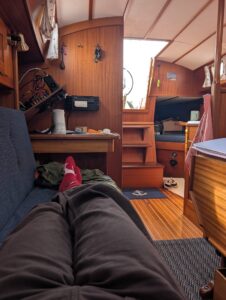
Delta Lady is 9.70 metres long. By house standards, that is not much space. There is a saloon, galley, sleeping space, storage, a small bathroom and many compartments that seem to contain either something essential or a cable whose purpose still needs investigation.
Everything is close. The galley, the sofa, the bed, the navigation table and the cockpit are all only a few steps apart. Cleaning does not take long, although it is still surprisingly easy to lose something inside a locker and discover it months later beneath an item you use every day.
The limited space forced me to become more selective. Every object needs a place. If it does not have one, it moves around while sailing, blocks another cupboard or becomes part of an unstable pile.
I started asking myself different questions.
Where will it live?
Can one object have more than one purpose?
A small boat does not necessarily feel restrictive. It can feel clear. There is less to fill, less to maintain and less distance between daily life and the world outside.
My home is small, but the view changed constantly.
Winter Aboard
Then winter arrived, and I learned that a boat is not a well insulated house.
Inside, it is often the same temperature as it is outside. The water around the hull influences the temperature, the windows become cold and the cabin cools quickly once the heating stops.
On some mornings, getting out of bed required negotiation. The warmest place was under the blankets. The floor was cold, the clothes felt cold and the air made a strong argument for staying exactly where I was.
The diesel heater made life much more comfortable, but the boat still did not behave like a normal home. Heat disappears quickly, and warm air meeting cold surfaces creates another problem.
Condensation.
Breathing produces moisture. Cooking produces moisture. Wet clothing produces moisture. Simply living inside a small enclosed cabin adds water to the air.
That moisture settles on windows, walls and cold corners. If the air does not circulate properly, mould appears.
And mould on a boat is persistent.
It hides behind cushions, beneath mattresses and inside lockers. It especially enjoys places that are difficult to reach and easy to forget.
I cleaned it, ventilated the boat, dried surfaces and moved cushions away from the hull. I considered whether a dehumidifier was worth the space it occupied. Sometimes it felt ridiculous to heat the boat and then open the hatches again to let cold air inside, but ventilation was necessary.
Winter taught me that a boat needs to breathe. Keeping everything tightly closed may preserve the heat for a while, but it also traps the moisture.
There was no single perfect solution. It became a continuous balance between heating, airflow, insulation and daily habits.
The Loneliness Behind the Romantic Picture
Living aboard has a romantic image. Morning coffee in the cockpit, sunsets over the water, freedom, simplicity and nature.
All of that is real.
But there is another side that is photographed less often.
Loneliness.
Living alone aboard can feel deeply peaceful, but the same silence can sometimes feel heavy. During the week, there were practical jobs, work, appointments and technical projects. At weekends, the marina could suddenly feel very quiet.
I had chosen independence, but independence does not remove the need for connection.
There were moments when I felt proud of everything I was doing alone. There were also moments when I wished another person was simply there.
Not because I could not cope, but because some experiences feel richer when they are shared.
That was one of the emotional lessons of my first year. Freedom and loneliness can exist at the same time. Loving an independent life does not mean always wanting to be alone.
I slowly understood that the life I wanted was not only freedom. It was freedom with connection. The space to travel, sail and make my own decisions, while still having people around me who genuinely wanted to be part of it.
When the Boat Became a Mirror
Living aboard left little distance between me and my own thoughts.
On strong days, I saw how much I could handle. I made decisions, solved problems, learned technical skills and worked towards a life that had once only been an idea.
On difficult days, I saw my fear, exhaustion and uncertainty much more clearly.
Sometimes I was incredibly productive. I would complete jobs, organise equipment and feel ready for any adventure. The next day, I could sit inside the cabin unable to decide what to do next, overwhelmed by everything that still needed attention.
A sailing dream looks simple from a distance.
Buy a boat.
Prepare it.
Leave.
In reality, it consists of hundreds of decisions about weather, routes, tides, bridges, locks, repairs, equipment, money, safety and navigation.
Each task is manageable on its own. Together, they can become mentally heavy.
I had to learn not only how to maintain a boat, but also how to carry the responsibility of a dream without turning it into a constant emergency.
Living With Nature
Living aboard made nature impossible to ignore.
In a house, bad weather may mean looking outside and deciding to stay indoors. On a boat, the weather changes everything.
The wind determines how the boat lies in the berth. It pulls on the lines, moves the rigging and changes whether leaving the marina feels easy or impossible. Rain changes the sound of the cabin. Cold enters through the hull. Sunlight can transform the interior within minutes.
I started checking the weather more and more. Not only the temperature, but also wind direction, gusts, pressure and approaching systems.
Weather became less like background information and more like a daily conversation.
A gust arrived and the boat responded. A wake entered the marina and the glasses moved slightly in the cupboard. The water level changed and the lines changed with it.
Living aboard created the closeness to nature I had wanted for a long time. I watched birds from the cockpit, saw the light move across the water and noticed the seasons through the temperature of the hull.
Nature was no longer a place I visited.
It was directly outside the cabin door.
Learning to Accept Help
I wanted to do a lot myself, partly to save money, but mainly because I wanted to understand my own boat.
I used AI, manuals, YouTube, friends and professionals. Sometimes I needed someone to hold the other end of a cable. Sometimes I needed a more experienced sailor to look at a problem. Certain jobs were deliberately outsourced because the risks were too high.
The first year taught me that independence does not mean refusing help.
It means remaining responsible for your own decisions.
I could accept assistance without giving away ownership of the process. I did not need to prove that I could do every single thing alone. I needed to build a life in which I could stand on my own and still allow other people to contribute.
Becoming Home
Over time, Delta Lady stopped feeling like a boat I had recently purchased.
She became home.
I knew which floorboard made a sound, which cupboard needed an extra push, where the morning light entered and how the cabin smelled after rain.
Every corner had a purpose. Every object had a place, or at least a location where I believed it belonged.
The boat still carried traces of her previous owners, but she increasingly carried traces of me too. New equipment, repaired systems, books, sailing clothes, tools, food, plans and memories.
A home is not created by size.
It is created by familiarity, care and the feeling that you belong there.
Delta Lady became that place.
One Year Later
Nearly one year after buying Delta Lady, both the boat and I have changed.
The electrical system is safer. The technical equipment is more modern. The batteries, charging system and solar installation are better suited to living aboard. I understand much more about the boat than I did on the day I first stepped inside her.
But the largest change is not technical.
At first, Delta Lady was an unknown boat full of systems I did not understand. Then she became a project, a challenge and eventually a safe place.
My first year aboard in the Netherlands was not simply a waiting period before the real journey. It was already part of the journey.
The cold winter mattered.
The first solo sail mattered.
The quiet evenings mattered.
The neighbours who kept an eye on the boat mattered.
The mould, the repairs, the fear and the moments of confidence all mattered.
Living aboard was not endless freedom, and it was not endless hardship. It was a strange and beautiful combination of responsibility, simplicity, vulnerability and possibility.
Delta Lady gave me less space than a normal home.
And somehow, inside that smaller space, my life became much larger.