From Shore Power to Solar Power: The Electrical Refit of Delta Lady
When I bought Delta Lady, my 1987 Najad 320, in August 2025, I knew that some of her technical equipment would need attention. What I did not yet understand was how closely everything on a boat is connected. Replacing one charger could affect the shore power system, the batteries, the fuses, the cables and even the sockets. Installing new navigation equipment could lead to questions about GPS data, networks, antennas and cables running through the mast.
The electrical refit therefore did not happen as one clearly defined project. It developed gradually as I learned what was already aboard, what was still reliable and what needed to be made safer or more suitable for living and travelling independently.
I did much of the work myself, sometimes with practical help from friends. I used AI extensively to understand unfamiliar concepts, watched many hours of YouTube, read equipment manuals and asked questions in marine shops. Some work, especially the most safety critical parts, was deliberately given to professionals.
My goal was never to replace everything simply because it was old. Delta Lady already had several systems that still worked well, including her wind instruments, autopilot and Navtex receiver. The refit was about keeping what remained useful while modernising the systems I needed to trust for longer journeys.
Starting With the 230 Volt Shore Power System
The first major project was not solar power or navigation electronics. It was the 230 volt shore power system.
When I moved aboard, the existing installation did not feel safe enough to continue using. I chose to have it removed, which meant spending roughly my first two weeks aboard without normal 230 volt electricity. It was inconvenient, but safety had to come before comfort.
During those weeks I became very aware of how much daily life normally depends on an ordinary socket. Charging a phone, running equipment and using household appliances suddenly required planning. At the same time, it made clear that the new installation had to be more than a temporary repair. It needed to form a safe foundation for the rest of the electrical system.
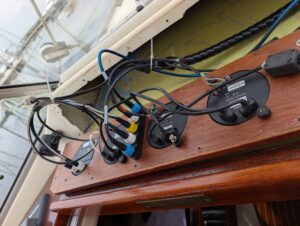
The shore power installation was rebuilt with proper protective equipment, including an RCD and circuit breakers. The RCD is designed to disconnect the electricity when it detects current flowing through an unintended path. The breakers protect the circuits against overloads and short circuits.
The installation was also divided into logical groups so that sockets, the battery charger and other equipment were not all relying on one unprotected supply. Delta Lady’s hot water boiler was part of this system as well. The boiler can heat water electrically when connected to shore power and can also use heat from the engine while motoring.
A galvanic isolator was added to the shore earth connection. Before this refit, galvanic corrosion was a completely new subject to me. When a boat is connected to a marina’s shore power, its protective earth can create an electrical connection with other boats and the marina infrastructure. Very small currents can then contribute to corrosion of underwater metals. The galvanic isolator helps block those small currents while allowing the protective earth to function during a genuine electrical fault.
Most of this work is hidden behind panels and inside lockers. It is not the most visible part of the refit, but it is one of the most important. The renewed 230 volt installation made the boat safer and created the basis for adding the new charger and inverter later.
Understanding the 12 Volt System
While the 230 volt system supplies household style equipment, most of the boat runs on 12 volts. Lights, pumps, navigation instruments, radio equipment, the refrigerator and many other systems depend on the batteries.
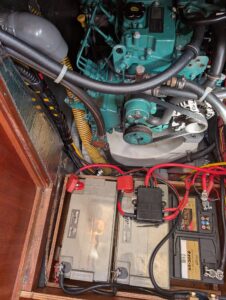
Delta Lady has a separate starter battery and a domestic battery bank. The starter battery is mainly responsible for starting the Volvo Penta D1 30 engine. The domestic bank supplies everyday life aboard and consists of two Victron GEL batteries of 110 Ah each, giving a nominal total capacity of 220 Ah.
At first, I thought of battery capacity almost like the contents of a fuel tank. Gradually I learned that the number on the label does not mean all of that energy should be used. GEL batteries need the correct charging profile and should not regularly be deeply discharged if they are to last.
The battery bank also needed proper protection. A 12 volt system may sound harmless, but a battery can deliver an enormous amount of current into a short circuit. A damaged or poorly protected cable can become extremely hot and create a serious fire risk.
For that reason, I had the main fuses and high current protection around the battery package professionally installed. I wanted to understand how they worked and why they were required, but this was not an area where I wanted to learn through mistakes.
Cable thickness became another important subject. In a 12 volt installation, high current and voltage loss matter greatly. Equipment such as an inverter needs very heavy cables, especially when the distance from the batteries increases. This is why the length, thickness and protection of a cable are just as important as the equipment connected to it.
Making the Energy Flow Visible
The Victron SmartShunt became one of the most useful parts of the system because it made the otherwise invisible energy flow measurable.
Battery voltage alone does not tell the complete story. Voltage changes depending on whether the battery is charging, resting or supplying a load. The SmartShunt measures current entering and leaving the domestic bank and estimates the state of charge.
Through the Victron app, I could suddenly see what happened when the refrigerator switched on, when the batteries were charged from shore power and when clouds passed over the solar panels. It became much easier to connect the electrical theory with what was actually happening aboard.
For a while, checking the app became a minor obsession. Every change felt interesting. The refrigerator started, the current moved. The sun returned, the charging increased. A device was plugged in and the energy consumption became immediately visible.
It was a simple but important shift. Instead of only hoping the batteries were fine, I could begin managing them based on information.
Charging Both Battery Banks
I also wanted the engine alternator to charge both the starter battery and the domestic bank while keeping them separated when there was no charging source.
For this, I installed a Victron Cyrix battery combiner. The Cyrix monitors the voltage of the batteries. When it detects that one side is being charged, it connects the battery banks so that the charging current can be shared. When the voltage falls again, it separates them to prevent the domestic loads from draining the starter battery.
The idea is straightforward. The practical installation involved heavy cables, connection sequences and a great deal of checking.
It also included one brief but effective lesson when a positive starter cable touched part of the alternator and produced a spark. Nothing appeared to be damaged and the starter battery still measured approximately 12.69 volts afterwards, but it was a convincing reminder that batteries must be isolated properly before working on their connections.
After the installation, I could sometimes hear the Cyrix click as it connected or disconnected. That small sound became reassuring because it confirmed that the system was responding to changing charging conditions.
Adding Solar Power
One of my main goals was to reduce my dependence on marina electricity. If Delta Lady was going to become a travelling home, she needed to generate a meaningful amount of her own power.
I added approximately 430 watt peak of Victron solar panels. That is a useful amount for a 32 foot sailing boat and can support daily consumers such as refrigeration, lighting, navigation equipment and the charging of smaller devices.
Solar power on a boat is less predictable than the number printed on the panel suggests. Actual production depends on the weather, the angle of the sun, temperature and shading. The mast, boom and rigging are very good at casting shadows across exactly the part of a panel that would otherwise be producing the most power.
The panels therefore needed more than a physical place aboard. They also needed the correct charge controller, wiring and protection.
A Victron MPPT controller manages the electricity from the panels. It continuously adjusts the operating point of the panels to obtain useful power and converts it into the charging voltage required by the batteries.
This project led me into questions about panel voltage, current, controller limits, fuse placement, cable size and the effects of connecting panels in series or parallel. AI was particularly useful here because I could ask one question and then continue until I understood the reasoning behind the answer. I always compared that information with the official Victron manuals and the specifications of the actual equipment.
The solar controller also connects to the Victron app, making the influence of clouds and shadows immediately visible. I learned to look beyond peak output and think more about total daily production. A short period of high output is less important than whether the panels replace the energy used over the entire day.
Replacing the Old Charger With a MultiPlus
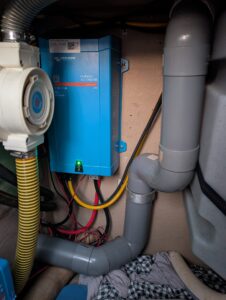
Once the shore power and battery systems were in better condition, the old battery charger was replaced by a Victron MultiPlus.
The MultiPlus combines a battery charger and an inverter. When Delta Lady is connected to shore power, it charges the domestic batteries and supplies the connected 230 volt circuits. When shore power is unavailable, it can convert electricity from the 12 volt battery bank into 230 volt power.
This allows me to use selected sockets away from a marina and charge equipment such as power tool batteries. It also connects the two main parts of the refit, because the MultiPlus belongs to both the 230 volt and the 12 volt systems.
Installing it required careful planning. It needed to be close enough to the batteries to keep the heavy DC cables reasonably short, while still having ventilation and protection from moisture. Finding an ideal location on a 32 foot boat is never easy because every suitable space already contains something else.
The MultiPlus also had to be integrated correctly into the renewed shore power system. Not every appliance should run from the inverter. Heavy consumers can drain a modest GEL battery bank very quickly, so the circuits had to be arranged sensibly. The hot water boiler, for example, belongs on shore power rather than being used casually from the batteries.
The installation produced many smaller questions that seem obvious only after they have been answered. How much insulation should be removed from a cable? Could bare copper go directly into the terminal? Which connection should be made first? When should the fuse be inserted? Why was the green connector refusing to come out?
At one point, pulling harder seemed like a possible strategy for the connector. Fortunately, I stopped before turning a new MultiPlus into several smaller pieces. It required the correct release method, not greater determination.
Once the system was working, I tested it briefly with an electric kettle. The kettle switched on, and the SmartShunt immediately showed a very large current leaving the battery bank. The experiment lasted around ten seconds, which was long enough to prove the inverter worked and short enough to demonstrate that heating water electrically is a serious load on a 12 volt system.
The MultiPlus made 230 volt power available away from shore. The SmartShunt showed the cost of using it. Together they taught me an important lesson: being able to power an appliance does not automatically make it sensible to do so.
Modernising Navigation and Communication
The refit also included the systems used for navigation and communication.
Delta Lady now has a Raymarine Axiom 9 chartplotter, which acts as a central display for charts, position information and data from other equipment. I kept the existing wind instruments, autopilot and Navtex because they remained useful. Modernising the boat did not mean removing everything old.
The VHF radio did need replacement. Reliable radio communication is essential for contacting harbours, locks, bridges, coastguard services and other vessels. The new radio can also receive GPS position information for Digital Selective Calling, allowing the boat’s position to be included in a distress alert.
A new AIS transponder was installed as well. An AIS receiver allows me to see other transmitting vessels. A transponder also broadcasts Delta Lady’s identity, position, course and speed, making her more visible to other AIS equipped vessels.
This is especially valuable in busy shipping areas, at night and in poor visibility. AIS does not replace keeping a proper lookout, but it provides another important layer of information.
The Antenna Problem
The new AIS and VHF equipment did not immediately lead to a perfectly working system.
After the mast had been removed and stepped again, the AIS began displaying an antenna fault. It could still receive some vessels, but transmission appeared unreliable. The VHF reception also seemed weak.
This turned into a long troubleshooting process involving the antenna, coaxial cable, connectors and the connection at the mast. The confusing part was that the cable had tested correctly before the mast work. That did not guarantee that it was still correct afterwards. A cable can be pinched, a connector can be disturbed and moisture can enter a connection.
The warning was probably related to reflected radio energy, usually described through VSWR. In a healthy antenna system, most of the transmitter’s energy travels through the coaxial cable and leaves through the antenna. When there is a damaged cable, poor connection or antenna problem, part of that energy can be reflected back toward the equipment.
The AIS detects this and may reduce or stop transmission to protect itself. Understanding the principle did not immediately identify the exact faulty component, but it made the warning far less mysterious.
It also demonstrated something important about marine electronics. A new and expensive device still depends on every cable and connector between the unit and the outside world.
Connecting the Equipment
The modern navigation equipment communicates through an NMEA 2000 network. This allows compatible devices to share information such as GPS position, speed, heading and AIS data through a common backbone.
The network uses T pieces, spur cables and terminators at both ends. It looks simple when drawn on paper, but a missing terminator or incorrect connection can produce confusing problems. One instrument may receive information while another reports that data is missing.
I also found older NMEA 0183 wiring aboard. This older system usually connects devices directly rather than through a shared network. It meant that Delta Lady contained several generations of electronics and wiring.
Some cables were clearly still relevant. Others disappeared behind panels and seemed to belong to a technical history that nobody had fully documented.
At one point, the VHF displayed “No position data”. This required checking the GPS source, network connections and antenna placement. The position later appeared, but the fault showed how dependent the devices had become on each other. A GPS problem can appear as a warning on the radio, even while another screen seems to be working normally.
Electricity for Everyday Life
The refit was not only about impressive equipment. Everyday consumers determine whether the system actually works for life aboard.
The refrigerator is one of the most important continuous loads. It does not draw the dramatic current of a kettle, but it cycles throughout the day and night. Its consumption depends on temperature, insulation, ventilation and how often it is opened.
Pumps and lighting usually consume less, but some of them are essential. A decorative light can fail without creating an emergency. A bilge pump cannot. Clear labelling and sensible fuse distribution therefore matter as much as the visible equipment.
Delta Lady’s Autoterm Air 4D diesel heater also relies on the 12 volt system. Although diesel provides the heat, the fan, control system and fuel pump need electricity. The heater also has to complete its shutdown cycle, which means its power supply must remain reliable.
These daily systems are the real test of the refit. Solar panels and batteries are only useful when they can support the ordinary rhythm of living aboard.
Doing It Myself and Knowing My Limits
I completed a large part of the work myself. I studied diagrams, followed cables, installed equipment, checked voltages and investigated faults. Friends occasionally helped with practical jobs or offered a second opinion.
I also spent a great deal of time in lockers and awkward corners that appeared to have been designed for a person with no spine and several extra elbows.
Doing the work myself saved labour costs, but more importantly, it helped me understand Delta Lady. When something fails while travelling, the person who installed it may be far away. Knowing how a system was built gives me a better chance of finding the fault or at least isolating it safely.
At the same time, I did not want enthusiasm to exceed competence. The 230 volt shore power work and the main high current fuse protection received professional help. These were areas where the consequences of a mistake were too serious.
Independence does not mean refusing expertise. It means understanding enough to make responsible decisions about when expertise is needed.
Learning With AI and YouTube
AI became an important part of the refit because it allowed me to ask questions at every level. I could begin with a basic concept and continue until the technical manual started making sense.
I asked about battery voltage, cable size, fuse positions, charging profiles, solar controllers, inverter loads, AIS faults and connection sequences. Some questions led directly to solutions. Others mainly helped me ask better questions when speaking to professionals.
YouTube added the visual side. Watching someone crimp a cable lug, open a connector or build a network made diagrams easier to understand. At the same time, I learned not to trust a video simply because the person presenting it sounded confident. An installation for a motorhome, a lithium battery or a different model of equipment is not automatically suitable for Delta Lady.
AI and YouTube were learning tools, not replacements for manuals, testing or professional judgement.
Some of my questions now seem amusing. Could I connect the bare copper directly? Why would the connector not come out when I pulled it? Did the MultiPlus automatically connect to the app? Was the spark still a problem if the battery voltage looked normal?
They were not foolish questions. They were the questions of someone learning a completely new subject. Knowledge often appears obvious only after it has been acquired.
Delta Lady Today
The electrical system aboard Delta Lady is now very different from the one I inherited in August 2025.
The 230 volt shore power installation has proper protection and distribution. A galvanic isolator helps reduce the risk of shore related galvanic corrosion. The old charger has been replaced by a MultiPlus, which charges the batteries from shore power and can supply selected 230 volt circuits from the domestic bank.
The two Victron GEL batteries are protected by proper main fuses and monitored through the SmartShunt. The Cyrix allows charging to be shared with the starter battery. Approximately 430 watt peak of solar panels provide energy away from marinas.
The navigation and communication systems include the Axiom 9, a new VHF radio, an AIS transponder and an NMEA 2000 network. Equipment that still worked, including the wind instruments, autopilot and Navtex, has remained aboard.
Not every issue is completely resolved. The antenna system still needs a definitive solution, and there will always be cables to improve, labels to add and future choices to make.
A boat is never truly finished.
But the largest difference is not the number of new devices. It is that I understand how the main systems work together.
I can follow the route from the shore power connection to the batteries. I can see what the solar panels produce and what the boat consumes. I understand why the starter battery must remain separate, why high current cables need protection and why an antenna fault can prevent a new AIS from transmitting.
I am not a marine electrician, and I am still learning. But I am no longer surrounded by completely mysterious boxes and cables.
Delta Lady is still very much a classic 1987 Najad. She has not become a floating technology showroom. The systems that remained reliable were kept, while the parts that needed greater safety, independence or reliability were renewed.
The refit made the boat better prepared for travelling.
It also made her more mine.